
Request a video call
Confirm Your Virtual Consultation
MexStemCells Clinic for Chronic Degenerative Wellness Profile Overview
Are You Looking for Another Option After Living With a Chronic Condition?
If your condition has continued despite treatment, it is understandable to look beyond standard care. Regenerative medicine can sound especially hopeful when pain, fatigue, reduced mobility or progressive symptoms have disrupted your life.
Hope should come with careful verification. Many cell-based applications marketed for joints, neurological disorders, kidney disease, diabetes, COPD, autism and anti-aging remain investigational. A sound decision starts with the exact cell product, regulatory pathway, evidence for your diagnosis and a realistic plan for complications.
You may be exploring this option because:
- Your symptoms continue despite medication, rehabilitation or other standard care.
- You want to understand whether a minimally invasive option could be appropriate.
- You have been told that surgery is premature, high risk or unlikely to address all symptoms.
- You are comparing treatment access and costs outside your home country.
- You are trying to separate laboratory promise from established clinical benefit.
- You need a clear explanation of what a licence does—and does not—confirm.
Common Search Terms
- stem cell therapy in Mexico City
- MexStemCells Clinic reviews
- stem cell treatment cost in Mexico
- regenerative medicine for chronic disease
- COFEPRIS licensed stem cell clinic
- stem cell therapy for joint pain in Mexico
How Chronic Symptoms Can Shape Your Search for Regenerative Care
Before you weigh a specific clinic, it helps to name the situation you are actually in. The four cards below describe the pattern I see most often among people considering regenerative treatment abroad for chronic degenerative conditions. If several of them describe you, you are in the group this decision was designed for, which is exactly why you need to be careful.
What You May Be Experiencing
- Joint pain that no longer settles with rest, and stiffness that is worst in the morning.
- Declining kidney function, rising creatinine, or fatigue that your nephrologist links to your labs.
- Neurological symptoms that are progressing despite disease-modifying medication.
- Breathlessness from COPD that limits how far you can walk before stopping.
- Autoimmune flares that keep returning between courses of treatment.
- Watching a child miss developmental milestones while therapy progress feels slow.
How It May Be Affecting Your Daily Life
- Stairs, long walks or standing at work have become things you plan around.
- Your calendar is organized around appointments, infusions or dialysis planning.
- Sleep is broken by pain, breathlessness or worry about what comes next.
- You have reduced hours, changed roles or stopped working altogether.
- Hobbies and travel you once took for granted have quietly dropped off the list.
- Family members have taken on caregiving tasks that neither of you expected.
What You May Have Already Tried
- Physical therapy, weight management and activity modification over many months.
- Anti-inflammatories, corticosteroid injections or hyaluronic acid for your joints.
- Immunosuppressants, biologics or disease-modifying drugs with partial response.
- Platelet-rich plasma or other orthobiologic injections closer to home.
- Dietary changes, supplements and alternative therapies of varying credibility.
- Second and third opinions that arrived at broadly the same conclusion.
What Often Leads People to Consider Stem Cell Therapy
- Being told that surgery is the only remaining option, and not being ready for it.
- A diagnosis where standard care manages symptoms but does not change the trajectory.
- Published prices abroad that are half to a third of quoted self-pay costs at home.
- Wanting to try something before further, irreversible damage accumulates.
- Patient stories and video testimonials describing meaningful improvement.
- The sense that time is passing and doing nothing also carries a cost.
Questions You Deserve Clear Answers To
- Am I actually a candidate, or will they accept me simply because I can pay?
- What cells will go into my body, where did they come from, and who tested them?
- What does the published evidence say about my specific diagnosis, not stem cells in general?
- What happens if I have a reaction after I have flown home?
- Who is the physician responsible for my case, and what is their registration number?
- If this does not work, what will I have lost besides the money?
Are You a Candidate for Regenerative Treatment at MexStemCells?
I have to be direct with you here, because this is where most guidance goes soft. For commercial stem cell therapy there are no universally accepted candidacy criteria of the kind you would find for a hip replacement or bariatric surgery. No professional body publishes a threshold that says you qualify. That absence is itself information: it exists because, for almost every condition on the clinic's list, the treatment has not been established through the trials that would produce such criteria.
What a careful evaluation should still involve:
- A confirmed diagnosis with imaging or laboratory evidence, reviewed before any treatment is offered to you.
- A clear account of which conventional options you have genuinely exhausted, and which you have not yet tried.
- Screening for active infection, active or recent cancer, uncontrolled bleeding disorders and pregnancy.
- A cardiovascular and respiratory assessment if you will fly to Mexico City, which sits at roughly 2,240 metres of altitude.
- An honest statement of what the clinic expects to achieve for you, expressed as a realistic range rather than a promise.
- Written informed consent that names the cell product, the route of administration and the known risks.
Important: The US Food and Drug Administration has stated that regenerative medicine therapies have not been approved for arthritis, hip or knee pain, vision loss, autism, chronic pain, Alzheimer's or Parkinson's disease, heart disease, lung disease or stroke, and that reports of blindness, tumour formation and infection have followed the use of unapproved products. A Mexican health licence permits a clinic to handle and administer these cells lawfully in Mexico. It does not mean any specific treatment has been proven effective for your condition.
Is MexStemCells Right for You?
MexStemCells is a better-documented option than many in this sector: it holds a verifiable federal health licence, names its physicians with checkable training histories, and publishes fixed package prices with stated inclusions. Those are meaningful signals, and I would weigh them positively. What they do not do is change the underlying evidence picture, which remains weak to absent for most of the conditions on its treatment list.
If you are treating a single arthritic joint, have realistic expectations and can absorb the cost without financial strain, this is a defensible thing to try after conventional care. If you are being asked to spend $7,500 or more on a progressive neurological disease, a failing kidney or a child's development, I would want you to seek a second opinion from a specialist with no financial interest in the answer before you book anything.
Quick Summary
- Location: Av. Thiers 42, Col. Anzures, Miguel Hidalgo, Mexico City, CP 11590, operating as Clínica de Rehabilitación Thiers S.C.
- Focus: Stem cell and regenerative protocols for chronic degenerative, orthopedic, neurological, autoimmune and metabolic conditions, plus longevity programs.
- Delivery: Joint packages combine a local intra-articular implant with an intravenous implant, plus exosomes and peptides.
- Prices: Published procedure prices from about $3,900; fixed joint packages at $5,590 to $5,890, with an extra joint at $1,500.
- Key decision: Is the evidence for your specific diagnosis strong enough to justify this cost and this travel, or are you paying for hope?
About MexStemCells Clinic in Mexico City
MexStemCells operates from a single site in Anzures, a central residential and diplomatic district of Mexico City, about a twenty-minute drive from the Polanco business area and roughly forty-five minutes from Mexico City International Airport in normal traffic. The federal health licence issued for the site names the operating entity as Clínica de Rehabilitación Thiers S.C. at Av. Thiers No. 42, Col. Anzures, Miguel Hidalgo, CP 11590. That address matches what the clinic itself publishes, and it matches independent medical travel directories. If a quotation you receive names a different legal entity or a different address, ask why before you send any money.
Dr. Rodolfo Lerma Espinosa has headed the medical team since 2014 and continues to work as a staff cardiologist at Hospital Central Militar. The clinic reports more than ten years of work in regenerative medicine, and the licences it holds date from 2013 and 2014, which is consistent with that. This matters to you practically: a cell therapy given intravenously carries cardiovascular and immune risk, so it is reassuring that the physician heading the team is a cardiologist with formal emergency and advanced life support training rather than a general practitioner. What you should still establish is which of the named specialists will personally assess you, perform your procedure and be reachable afterwards.
| Key fact | What is confirmed | What you should verify |
|---|---|---|
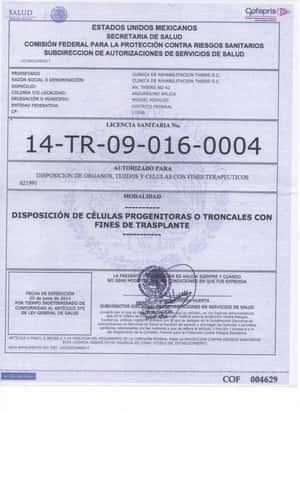
| Stem cell licence | COFEPRIS sanitary licence No. 14-TR-09-016-0004, issued 5 June 2014 for the handling of organs, tissues and cells for therapeutic purposes, in the modality of progenitor or stem cells for transplant. The document states it is valid for an indefinite term under Article 370 of the General Health Law, provided the conditions of issue are unchanged. | That the licence remains in force today, that the conditions of issue have not changed, and that the specific cell product proposed for you falls within the authorized modality. |
| Additional licences | The clinic reports two further COFEPRIS registrations: ambulatory surgical procedures, No. 13-AM-09-016-0009 issued 16 July 2013, and blood transfusion service, No. 14-TS-09-016-0007 issued 12 March 2014. | Ask for legible copies of both. The underlying documents were not publicly retrievable during this review, so at present these two rest on the clinic's own account. |
| Transplant registry | Mexican law requires establishments handling cells for transplant to hold a COFEPRIS licence and to be registered with the National Transplant Centre, CENATRA, with an internal transplant committee. | Ask for the clinic's CENATRA registration and the name of the sanitary officer responsible for the establishment. This is a reasonable, routine request. |
| International access | Consultations are conducted in Spanish and English; Dr. Lerma's published background lists Spanish as native and English at professional level. Joint packages include ground transport between airport, hotel and clinic. | Whether your treating physician, and not only a coordinator, speaks your language, and whether interpretation is available during consent. |
| Emergency capability | The clinic is an outpatient facility. Dr. Lerma holds advanced cardiac, trauma and prehospital life support certifications and works at a major military hospital in the city. | Which hospital you would be transferred to if you reacted badly to an intravenous infusion, how far it is, and who pays for that admission. |
A health licence authorizes a facility to carry out defined activities under national law. It is not an assessment of whether a treatment works, and it does not guarantee your result or your safety.
Conditions Treated at MexStemCells & How the Evidence Differs
The table below exists to help you compare, not to point you toward one option. The clinic groups its work into ten condition categories, and the honest position is that they do not all sit in the same place scientifically. Orthopedic joint injection has a genuine, if unsettled, research literature behind it. Several of the other categories do not. Read the row that applies to you rather than the list as a whole.
| Condition category | What the clinic offers | When it may be considered |
|---|---|---|
| Articular and orthopedic Knee, hip, shoulder, ankle, hands, herniated discs |
Fixed packages combining an intra-articular implant with an intravenous implant, exosomes and peptides. Published at $5,590 to $5,890, with an additional joint at $1,500. | After physical therapy, weight management and conventional injections have been tried, when you want to postpone or avoid joint replacement. |
| Chronic degenerative Diabetes, kidney failure, liver disease |
Intravenous protocols. Published prices from $6,500 for diabetes and $6,800 for kidney failure, with ranges rising to $9,500. | Only alongside, never instead of, the nephrology, hepatology or endocrine care you already receive. |
| Neurodegenerative Parkinson's, ALS, stroke recovery, brain injury |
Systemic protocols; the ALS entry describes a ten-day course. Published from $7,500, rising to $9,500, with brain injury at $8,500 upward. | Where you have discussed it with your neurologist and understand that this is not a disease-modifying therapy in the regulatory sense. |
| Immunological Rheumatoid arthritis, multiple sclerosis, Crohn's disease |
Intravenous protocols. Published at $7,500 upward for rheumatoid arthritis, $7,900 upward for multiple sclerosis and $7,900 upward for Crohn's disease. | When biologic or immunomodulatory therapy has given only partial control and you remain under specialist follow-up. |
| Respiratory and cardiac COPD, post-infarction recovery |
Systemic protocols; COPD is published at $7,200 to $7,500. | Only with cardiology or pulmonology input, particularly given the altitude of Mexico City. |
| Developmental and longevity Autism, developmental disorders, anti-aging |
Published from $6,500 for autism protocols and from $5,500 for longevity and anti-aging programs. | This is the category where I would counsel the most caution, particularly for children. |
Cell Sources and Delivery Routes: What to Pin Down in Writing
| Element | What is published | What to ask before you consent |
|---|---|---|
| Cell type | Adult mesenchymal stem cells are described as the basis of the protocols; the ankle package specifies mesenchymal stem cells placed into the joint. | The tissue of origin, the cell count you will receive, the viability figure, and the laboratory that released the batch. |
| Donor or your own cells | Dr. Lerma's published background refers to both autologous and allogeneic cellular infusions, so both appear to be used depending on protocol. | Which one applies to you. If donor cells are used, ask about donor screening, infectious disease testing and traceability documentation. |
| Local implant | Intra-articular injection into the affected joint, performed under local anaesthetic. | Whether ultrasound or fluoroscopic guidance is used, which matters considerably for hip and deep joint accuracy. |
| Intravenous implant | A systemic infusion is included in the joint packages alongside the local injection. | What clinical purpose the systemic dose serves in your case, how long you are monitored afterwards, and what is on hand to treat a reaction. |
| Exosomes and peptides | Both are included as additions to the joint packages and described as signalling and repair boosters. | The FDA has issued a specific public safety notification on exosome products. Ask what these contain, who manufactures them, and whether you can decline them. |
The Medical Team at MexStemCells: Who Would Actually Treat You
The clinic names five specialists spanning rehabilitation, surgery and transplantation, cardiology, haematology and cellular biology. That breadth is genuinely useful, but a list of names is not a care plan. Before you travel, ask for the treating clinician to be confirmed in writing, by name, along with their Mexican professional licence number, or cédula profesional, which you can check independently.
What I Recommend You Verify Before Paying
- The name and cédula profesional number of the physician who will perform your procedure.
- A current copy of COFEPRIS licence 14-TR-09-016-0004 and confirmation it has not been modified or suspended.
- The clinic's CENATRA registration and the identity of its designated sanitary officer.
- A written treatment plan naming the cell type, dose, route and number of sessions, with the total price.
- The informed consent document in a language you read fluently, sent before you travel rather than on the treatment day.
- Written confirmation of what happens, clinically and financially, if you have a complication after returning home.
Patient Stories: What They Can and Cannot Tell You
The clinic publishes written and video testimonials, and they are worth reading. A family describes improved communication and calmer behaviour in a son treated for autism. A patient with chronic kidney disease reports better laboratory results and more energy. Several people describe less joint pain and easier walking after knee or finger treatment. A Canadian couple mentions that everything was explained to them in English. These read as sincere accounts of real experiences.
Here is what they cannot tell you. None of these people had a comparison group, so there is no way to know what would have happened without the treatment. Most chronic conditions fluctuate, and people typically seek treatment at their worst point, which means some improvement is expected regardless. Many patients receive physiotherapy, medication adjustments or behavioural therapy in the same period, and those effects cannot be separated from the injection. Expectation itself produces measurable symptom improvement, particularly for pain. And you are only seeing the patients who chose to speak; you have no way to see those who felt nothing, or who had a complication.
I would treat the testimonials as evidence that the clinic communicates well and treats people kindly, which matters. I would not treat them as evidence that the therapy works. Those are different claims, and only one of them is supported by what you are reading.
Risks You Should Weigh Before Travelling for Cell Therapy
I want to be clear about the state of the evidence, because this is where a decision like yours is either well made or badly made. For knee osteoarthritis, which is the best-studied application on offer here, the American Academy of Orthopaedic Surgeons reviewed the literature and could not recommend for or against cell-based injection, because the quality of the evidence was insufficient. For the neurological, kidney, metabolic and developmental applications, the position is weaker still: no such product is approved for those uses, and the FDA has documented reports of blindness, tumour formation and serious infection following unapproved cell and exosome products. Regenerative medicine is a promising field. That is not the same as a proven treatment for your diagnosis, and anyone who tells you otherwise is overselling.
| Time period | Potential concerns | Questions to ask |
|---|---|---|
| Procedure day | Infusion reactions including fever, chills, rash, breathlessness or a drop in blood pressure; pain, swelling or bleeding at an injection site; vasovagal episodes; rare but serious embolic events with intravenous cell products. | How long will I be observed after the infusion? What emergency medication and equipment are in the room? Who is the physician present, not on call? |
| First days to weeks | Joint infection after intra-articular injection, which is uncommon but serious; a flare of joint pain and swelling; systemic infection; deep vein thrombosis associated with the flight home; immune reaction to donor cells. | What symptoms mean I should go to an emergency department rather than message the clinic? Who do I contact, in what language, at what hour? |
| Long term | No measurable benefit despite significant expense; progression of the underlying disease during the months spent waiting for a response; delayed access to an effective conventional treatment; possible loss of eligibility for future clinical trials; unknown very-long-term effects of cultured cell products. | At what point should I conclude this has not worked? Does the clinic collect and publish outcome data on its patients? Will a repeat session be recommended, and at what cost? |
Seek urgent medical care for fever above 38°C, a hot, swollen or intensely painful treated joint, severe headache with a stiff neck, new confusion, weakness or vision change, chest pain, sudden breathlessness, or swelling and pain in one calf. Do not wait until you are home and do not wait for the clinic to reply. Go to the nearest emergency department and tell them you have received a cell therapy, naming the product and the date.
Your Journey from First Question to Life Back Home
Starting Point
You decide standard care is not enough
Write down, in plain language, what you want to be able to do that you cannot do now. Walk a kilometre. Sleep through the night. Delay dialysis. That sentence becomes the measure you judge everything against, including the clinic's answers.
Initial Research
You separate the condition from the sales pitch
Search the published evidence for your exact diagnosis, not for stem cells in general. If the strongest available statement is that the evidence is insufficient, you now know what you are buying: a possibility, not a treatment.
Before Travel
You gather your records and a second opinion
Assemble imaging, recent bloodwork, your medication list and your specialist's notes. Then show the proposed protocol to a doctor who earns nothing from your decision. That single step protects you more than any amount of online reading.
Clinical Review
The clinic evaluates your case remotely
Expect questions about your diagnosis, history and current medication. Be wary of an evaluation that accepts you within hours without requesting imaging or labs. A clinic that occasionally says no is a clinic worth taking seriously.
Decision Stage
You get the whole plan in writing
Cell type, dose, route, number of sessions, total price, what is excluded, and what happens if a complication occurs. If any of these arrives only verbally, that is your answer about how the rest will go.
Planning Stage
You book around a three to four day stay
The joint packages assume arrival, a treatment day, a rest day and departure. Book a flexible return, arrange travel insurance that covers medical repatriation, and tell someone at home your exact itinerary.
Arrival in Mexico City
You land and give yourself time to adjust
Ground transport between airport, hotel and clinic is included in the joint packages. The city sits at about 2,240 metres, so take the first evening gently, hydrate, and mention any breathlessness to the team before your procedure.
Treatment
Consultation, then local and intravenous implants
The packages describe a consultation, a joint injection, an intravenous infusion with exosomes and peptides, and a recovery period at the clinic. Ask for the batch or lot documentation for what you receive, and keep a copy.
Early Recovery
A rest day before you fly
Most people are mobile immediately, with high-impact activity discouraged for several weeks. Use the rest day to watch for fever, spreading redness or worsening joint pain, and to raise anything unusual while you are still in the city.
After Returning Home
You track results honestly against your own baseline
Structural change, if it occurs, is described as peaking between three and six months. Give your own doctor the full treatment record, keep your regular care going, and measure against the sentence you wrote at step one rather than against how you feel on a good day.
Travel-safety reminder: Anyone travelling more than four hours by air, car, bus or train can be at risk of a blood clot. Choose an aisle seat, walk every couple of hours, flex your calves while seated, stay hydrated, and speak with your doctor before you fly if you have had a clot before or have another risk factor. Tell the clinic about any anticoagulant you take before your procedure is scheduled.
What Treatment at MexStemCells Actually Costs
The clinic publishes both a procedure price list and fixed joint packages, which is more transparency than much of this sector offers. Note that the starting figures and the quoted ranges differ, and that the figures shown in the two published sources do not always agree. Treat every number below as a starting point for a written quotation rather than a final price.
Published Prices by Treatment Area
| Treatment area | Published starting price | Published range | What is stated about inclusions |
|---|---|---|---|
| Knee, hip, hands or ankle package Fixed joint packages |
$5,590 to $5,890 | Add $1,500 per extra joint | Consultation, local joint implant, intravenous implant, exosomes and peptides, and ground transport between airport, hotel and clinic. Airfare, hotel, meals, imaging and take-home medication are excluded. |
| Sports medicine and general joints Price-list entries |
From $3,900 | $3,900 to $5,990 | Knee arthritis is listed separately at $5,300 to $5,500 and shoulder at $6,000; inclusions are not stated on the price list itself. |
| Chronic degenerative Diabetes, kidney, liver |
From $6,500 | $6,500 to $9,500 | Kidney failure is published at $6,800 upward in one place and $6,500 upward in another; ask which applies to you. |
| Neurological and autoimmune Parkinson's, ALS, MS, RA, Crohn's |
From $7,200 | $7,200 to $9,500 | The ALS entry describes ten days of treatment. Multi-day protocols mean longer accommodation costs that sit outside the quoted price. |
| Longevity, anti-aging and autism Wellness and developmental programs |
From $5,500 | $5,500 to $9,500 | Autism protocols are published from $6,500 to $8,500. Ask how many sessions the figure covers and whether repeat visits are anticipated. |
The Quote Checklist: Confirm Each of These in Writing
| Cost area | Confirm as included or excluded | Why it matters |
|---|---|---|
| Pre-treatment imaging and labs | Usually excluded; the joint packages state that imaging should be brought by you or arranged at extra cost. | An MRI arranged at short notice on arrival is both expensive and a poor basis for a decision you have already paid for. |
| Number of sessions | Joint packages describe a single session; longer protocols such as the ten-day ALS course clearly differ. | If a second session is likely to be recommended at three or six months, your real cost is double the headline figure. |
| Additional joints or sites | Explicitly $1,500 per additional articulation. | Bilateral knee arthritis is common. Establish before you travel whether one or both knees are in your quotation. |
| Accommodation and meals | Excluded, although transport between hotel, airport and clinic is included in the joint packages. | Three to four nights in central Mexico City, flights and meals for you and a companion can add a substantial amount to the total. |
| Complications and follow-up | Not addressed in the published material. | This is the single most important gap. Establish who pays for an extended stay, a hospital admission or treatment of an infection at home. |
Before you transfer any deposit, ask for a single written estimate on clinic letterhead that names your treatment, every inclusion and exclusion, the total in US dollars, the refund terms if you are found unsuitable on arrival, and who bears the cost of a complication.
Planning Your Trip to Mexico City
Getting There
Mexico City International Airport receives direct flights from most major North American and several European cities. The clinic sits in Anzures, centrally located and roughly forty-five minutes from the airport in typical traffic. Ground transfers are included in the joint packages.
Entry and Currency
Check your own country's current entry requirements for Mexico well before booking, since these change. Prices are published in US dollars; confirm which currency the clinic actually charges in and what card or transfer fees apply, as these can add several percent.
Language and Support
Consultations are offered in Spanish and English, and patients have described clear English communication. If you speak neither fluently, arrange professional interpretation for the consent conversation specifically, not just for the logistics.
Questions You Are Probably Asking About MexStemCells
What conditions does MexStemCells actually treat?
The clinic groups its work into ten categories: joint and orthopedic conditions, heart conditions, COPD, neurodegenerative disease such as Parkinson's and ALS, chronic degenerative disease including diabetes and kidney failure, immunological conditions such as rheumatoid arthritis and multiple sclerosis, rejuvenation and aesthetic treatment, developmental disorders including autism, stroke recovery, and general functional improvement. That is a very wide range for one facility, and you should read it as a list of what can be purchased rather than a list of what has been proven.
Is this proven, or am I paying for something experimental?
For almost every condition on the list, you are paying for something experimental being delivered outside a clinical trial. The FDA states that regenerative medicine therapies are not approved for arthritis, joint pain, vision loss, autism, chronic pain, Alzheimer's, Parkinson's, heart disease, lung disease or stroke. For knee osteoarthritis, the strongest case here, orthopedic guidelines found the evidence insufficient to recommend for or against cell-based injection. I would want you to hold that clearly in mind, and to hear the clinic acknowledge it, before you commit.
What licensing does the clinic hold, and can I check it?
Yes, and you should. The Mexican federal health regulator COFEPRIS issued sanitary licence No. 14-TR-09-016-0004 on 5 June 2014 to Clínica de Rehabilitación Thiers S.C. at Av. Thiers 42, authorizing the handling of organs, tissues and cells for therapeutic purposes in the modality of progenitor or stem cells for transplant. The licence document is available and states an indefinite term under Article 370 of the General Health Law. Two further registrations, for ambulatory surgery and blood transfusion services, are reported by the clinic; ask to see those documents directly.
Does that licence mean the treatment is safe and will work?
No, and this distinction matters more than almost anything else here. A sanitary licence authorizes a facility to carry out defined activities under Mexican law, following inspection of its premises, records and personnel. It is a statement about the establishment, not about clinical effectiveness. No regulator has assessed whether the cells will help your kidney, your knee or your child. Anyone who presents the licence as proof of efficacy is telling you something the document does not say.
Who are the doctors, and who would be responsible for me?
Dr. Rodolfo Lerma Espinosa has led the medical team since 2014; he trained in medicine at the Military School of Medicine, specialized in cardiology and cardiac rehabilitation, and works as a staff cardiologist at Hospital Central Militar. The team also includes Dr. Nayeli Trejo Bahena in rehabilitation and traumatology, Dr. Edgar Enrique Ramos Diaz in general surgery and transplants, Dr. Juan Uriarte in haematology and haematopoietic cell transplantation, and Javier Sanchez Gonzalez, who holds a master's and doctorate in cellular biology. I recommend you ask which of them will personally evaluate you, and request that person's Mexican professional licence number.
What will it cost me and how long will I be away?
Published prices run from about $3,900 for sports medicine to $8,900 for the immunotherapy protocol, with most condition-specific treatments falling between $5,500 and $9,500. The fixed joint packages are $5,590 to $5,890 and include consultation, local and intravenous implants, exosomes, peptides and ground transport, with an additional joint at $1,500. Those packages assume a three to four day stay. Flights, hotel, meals and imaging are yours to pay separately, and a companion roughly doubles the travel cost.
What happens with follow-up, and will my insurance cover any of this?
The packages describe remote follow-up to track progress rather than scheduled in-person review, and effects on joint structure are said to develop over three to six months. Assume your insurer will not cover a treatment that is not approved in your home country, and check before you travel rather than after. I would also ask your own doctor, in advance, whether they are willing to receive the treatment record and monitor you afterwards. Some will decline, and it is better to know that now.
What should I ask about complications before I agree to anything?
Ask four things and insist on written answers. First, what adverse events have occurred in patients treated with this protocol, and how many. Second, which hospital you would be transferred to in an emergency, and who pays. Third, who is medically responsible for you between the time you fly home and your recovery, and how to reach them out of hours. Fourth, what the clinic will and will not do if the treatment produces no benefit. A clinic that answers these calmly and specifically is demonstrating something important about how it will behave if things go wrong.
Ready to Find Out Whether This Is Right for Your Condition?
The only way to move past general information is to have your own diagnosis, imaging and history reviewed by the clinical team, and to receive a written plan you can take to your own doctor for a second opinion. Share your medical records for a personalized review, ask every question set out above, and treat the quality of the answers as part of your assessment.
Request Your Personalized ReviewMedical Disclaimer
This information is for education only and is not medical advice, a diagnosis, or a recommendation to undergo stem cell or regenerative treatment. Stem cell therapies for the conditions described here are not approved by the US Food and Drug Administration or comparable regulators, and for most of these conditions their safety and effectiveness have not been established in controlled clinical trials. Outcomes vary between individuals and no result can be guaranteed. Licensing by COFEPRIS or any other authority does not confirm that a treatment is effective. Do not stop, delay or change any prescribed treatment based on this information. Discuss any proposed regenerative therapy with a qualified physician who has no financial interest in your decision before you proceed.
References and Verification Sources
- MexStemCells Clinic — Clinic overview, treatment categories, medical team and certifications
- MexStemCells Clinic — Published treatment prices by procedure
- MexStemCells Clinic — Knee joint package: price, inclusions and exclusions
- COFEPRIS — Sanitary licence No. 14-TR-09-016-0004 for progenitor and stem cell handling (PDF)
- COFEPRIS — Sanitary licensing categories for health service establishments in Mexico
- US Food and Drug Administration — Consumer alert on regenerative medicine products including stem cells and exosomes
- International Society for Stem Cell Research — Patient guide to stem cell treatments and what to ask
- American Academy of Orthopaedic Surgeons — Clinical practice guideline on non-arthroplasty management of knee osteoarthritis
MexStemCells Clinic for Chronic Degenerative Wellness Certificates


Location

About Medical Center
- Speciality: Chronic Diseases, Stem Cell Therapy for Longevity
- Location: Thiers 42, 11590 , Mexico City , Mexico
- Overview: MexStemCells Clinic in Mexico City offers advanced stem cell therapy with over 20 years of experience, supporting regenerative wellness, healing, vitality, and improved quality of life. Recognized amo












Share this listing